Tag engineering brief
Everything mechanical, electrical, software and test teams need to start in parallel: architecture, envelope, ratings, perception, behaviour, the experience every subsystem must deliver, and how each is verified.
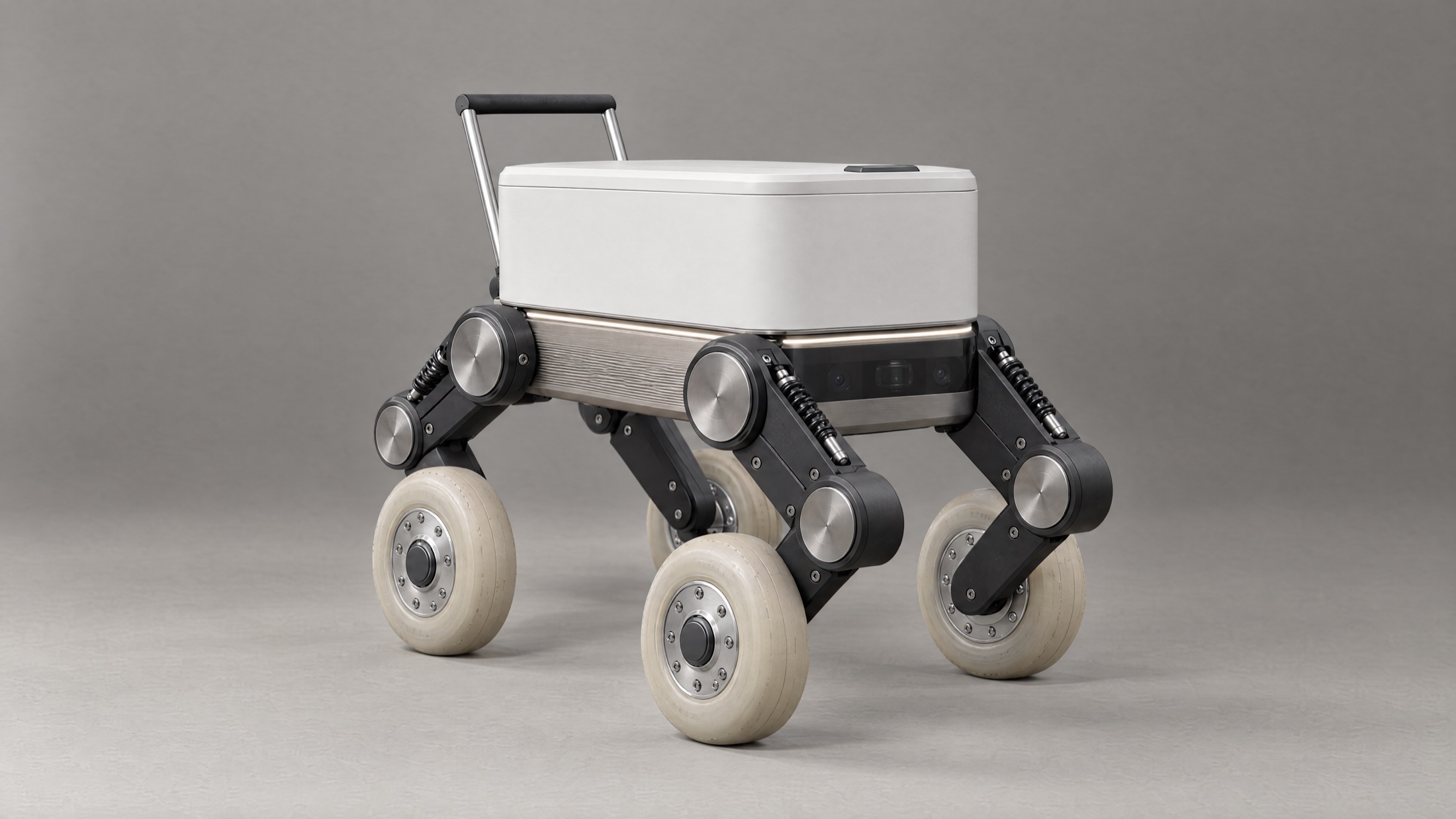
1. Product
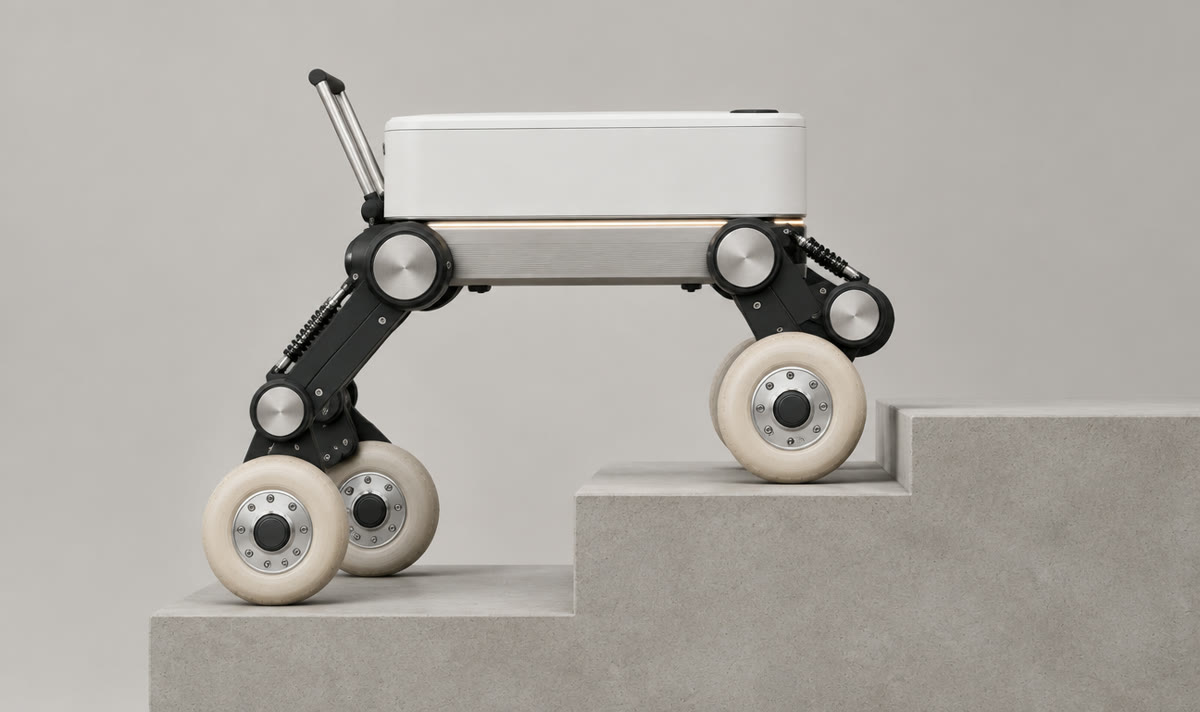
A personal and building carrying robot. It walks beside one person or runs a delivery alone, carries a full grocery order in a locked, covered bay, climbs stairs and kerbs, crosses trails, steps into a car boot and folds to a bench at the door. It rises to the working height of whoever is using it, rests on its own charging dock between jobs, and is set up and run from a phone app, with every daily task also possible without one. Sold to households and leased to buildings as fleets.
- Never ask a person to lift it, bend to it, or chase it. A breach is a defect.
- Predictable before clever. Anyone nearby can tell what it will do next.
- One platform. Use cases are modules and software, never hardware variants.
- Looks and behaves like a well-made object, not a lab robot or a medical aid.
2. Revision C changes
| Area | Rev B | Rev C | Reason |
|---|---|---|---|
| Wheels | Black airless | Cast polyurethane, bone colour, machined hubs | Quieter indoors, wet grip, wear life, no punctures; reads as real industrial hardware |
| Front sensing | Exposed dome | One flush smoked-glass pane, lidar and stereo behind | Nothing to snag or break; cleanable; calmer face |
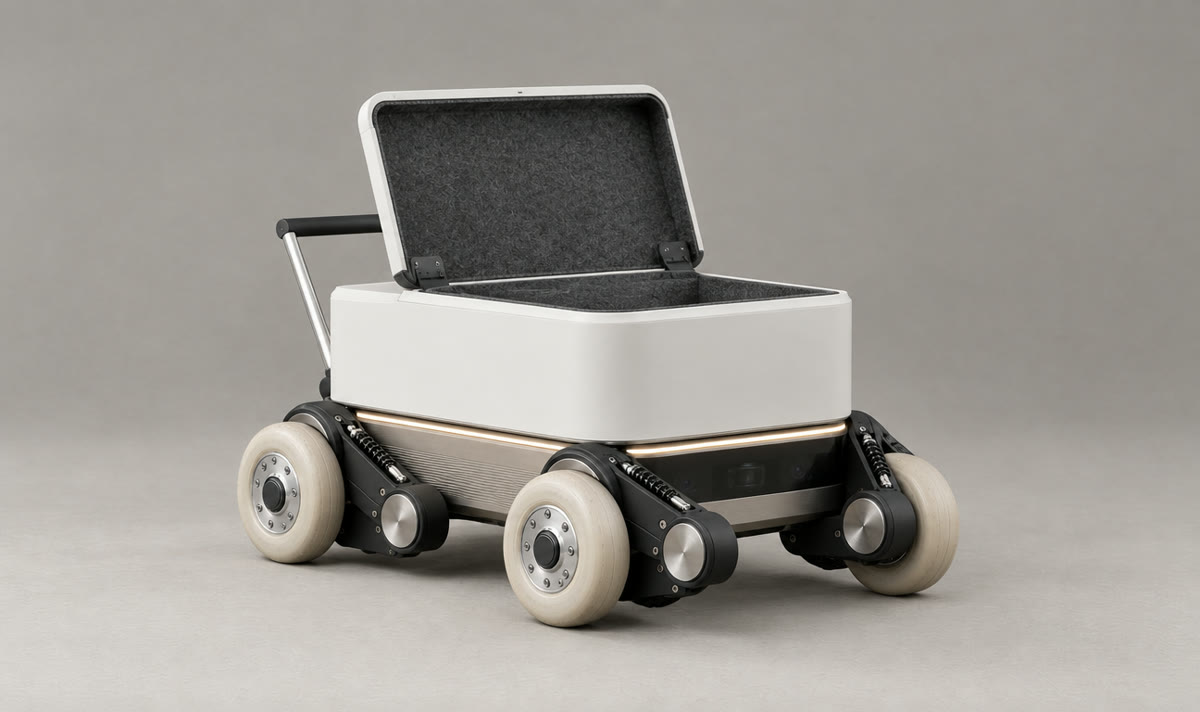
| Bay | 62 L tote module | 75 L integral covered bay, felt-lined, lit, lockable | Fits a $200+ order including a 24-bottle water case |
| Legs | Plain links | CNC aluminium plates, coil-over shock per thigh, hex fasteners | Visible strength; tunable compliance |
| Child seat | Two-seat bench | Nest: one deep seat set into the body | Safe ingress at waist height; harness interlock |
| Car entry | Unprotected | Boot mapping, 5 cm clearance rule, protective mat, 15 N stop | No paint contact, ever |
| Buildings | Concept | Lobby dock, lift API, access control, proof of delivery | Second business line |
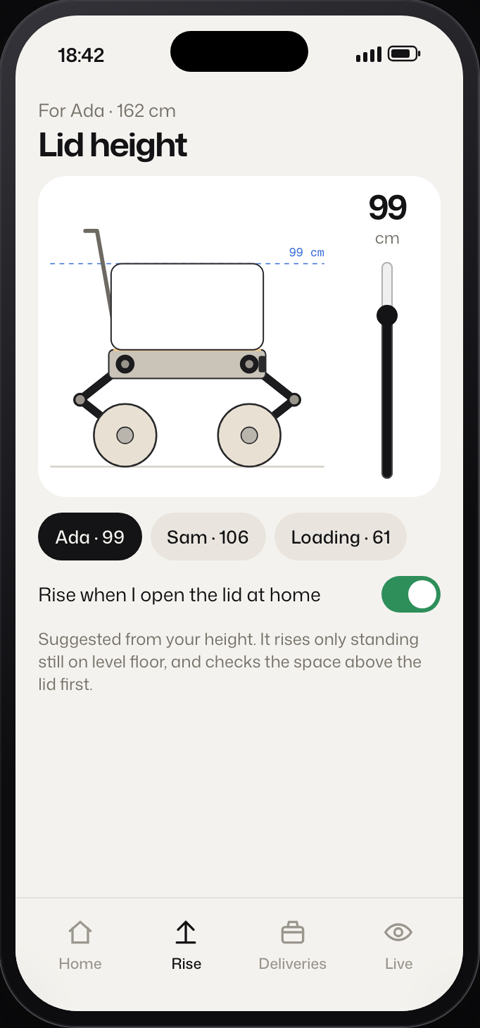
| Rise C.1 | None | Lid height 61 to 110 cm, set per person; hand-guided by the lid grip | R1: nobody bends to it |
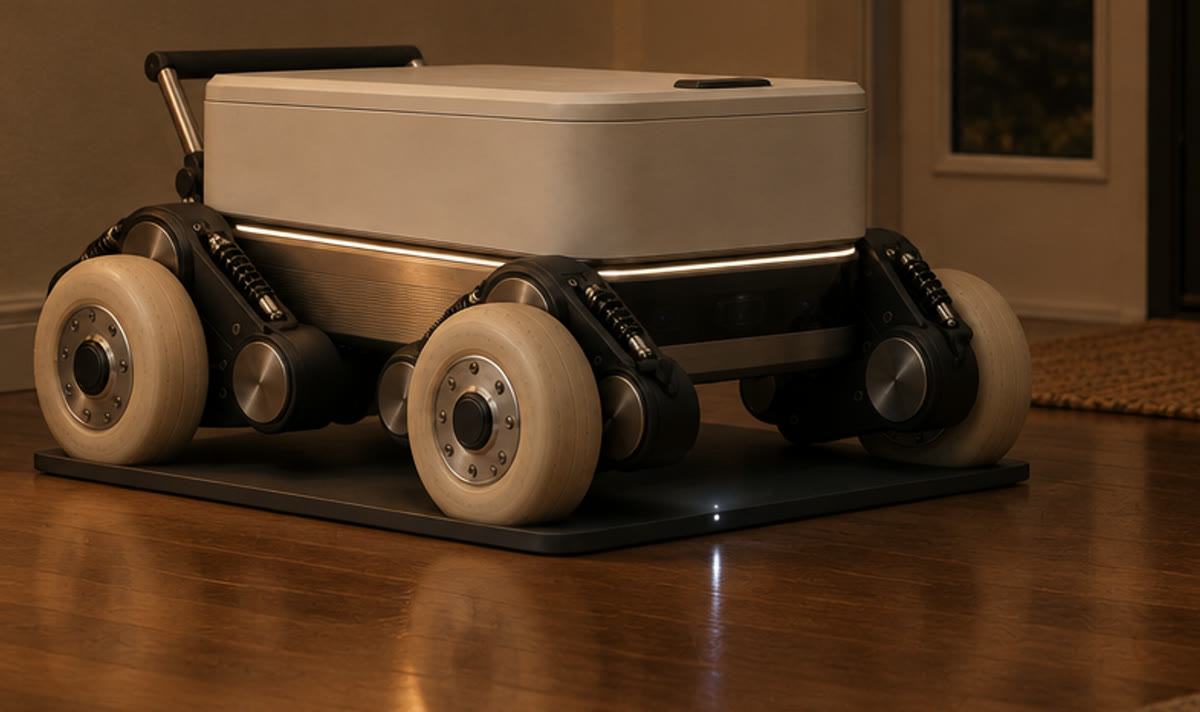
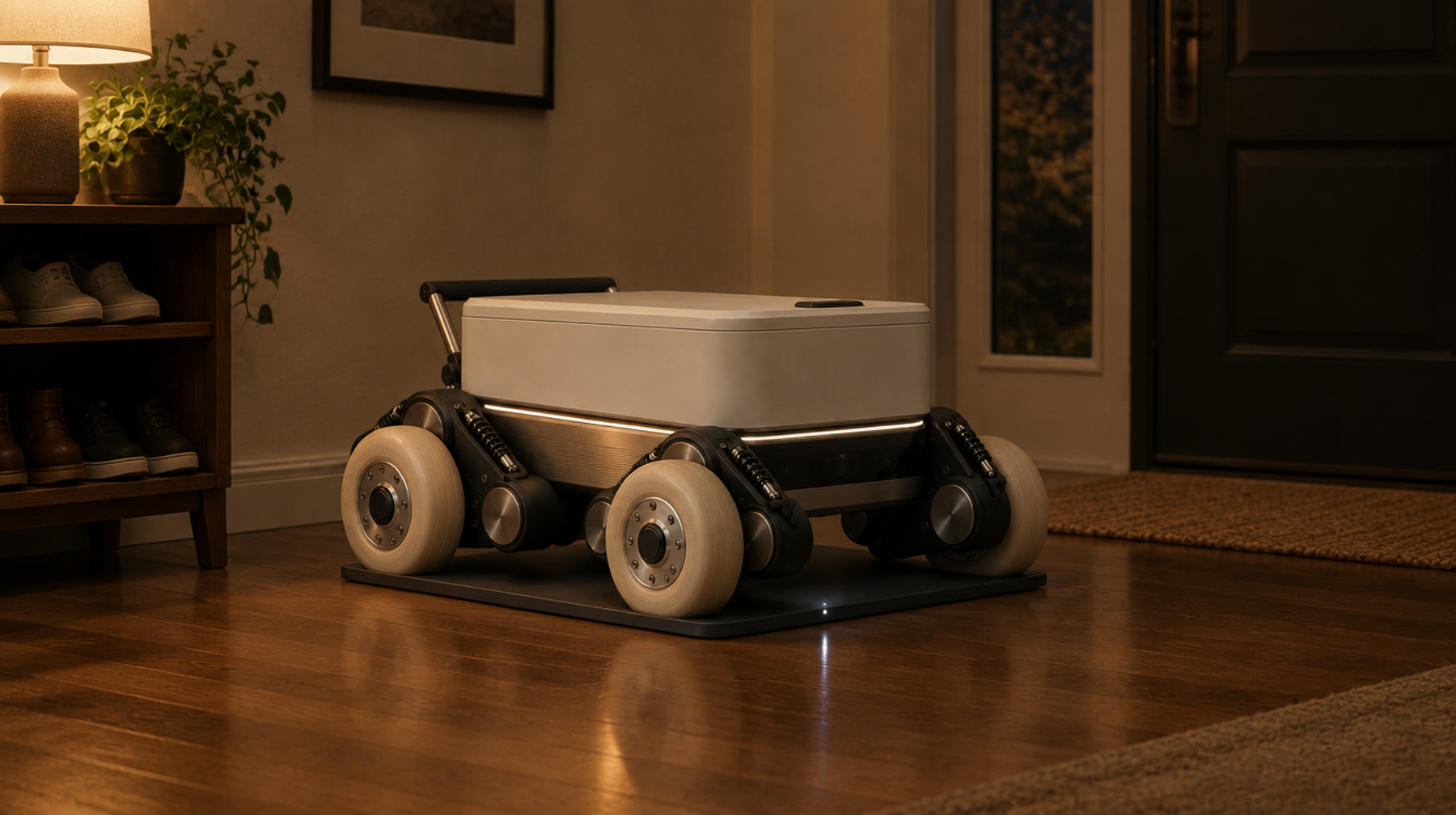
| Rest and dock C.1 | Pads under chassis | Drive-on plate, kneel-to-contact, sensors off at rest | Charges itself; private and safe when idle |
| Mobile app C.1 | Settings only | Setup, call, rise, deliveries, live view, household roles | One place to run it; never required for safety |
3. Architecture
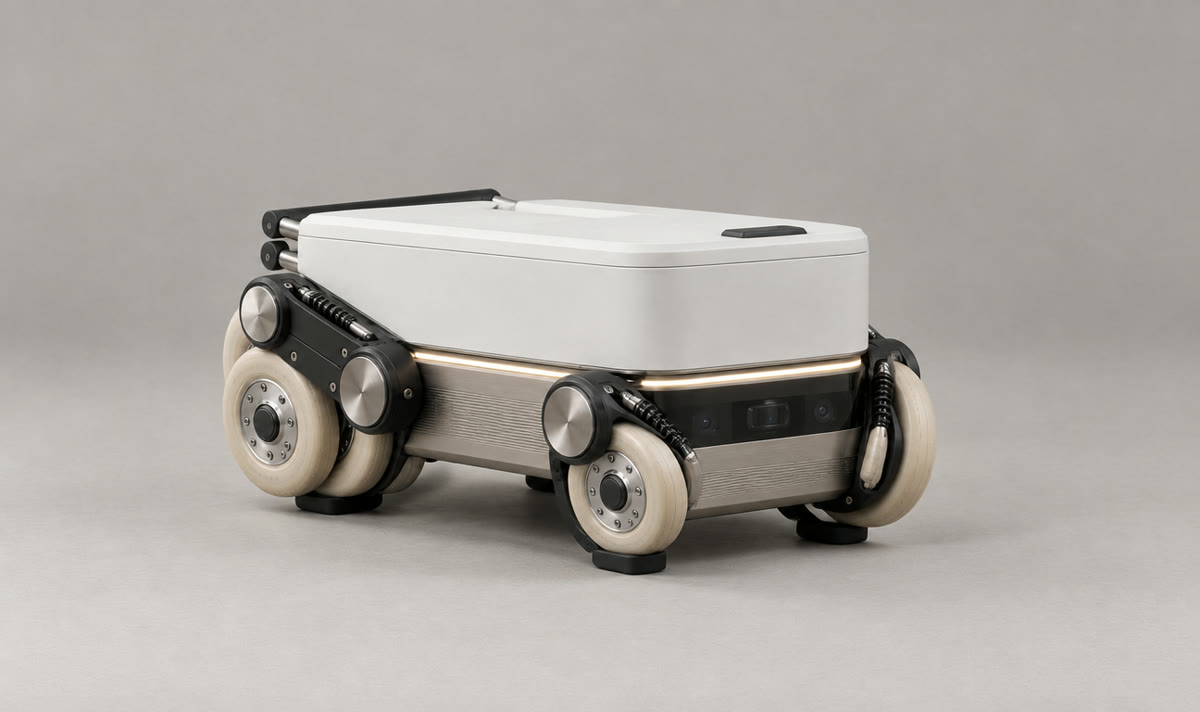
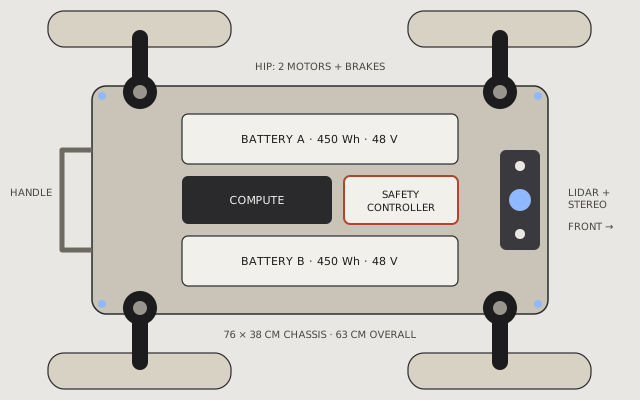
Body. Lower chassis: 76 × 38 × 14 cm anodised aluminium unibody (bead-blasted warm titanium), carrying two battery packs, compute, safety controller and the module deck. Machined cooling ribs on both sides over the battery bay. Upper shell: chalk-white PC-ABS over a glass-fibre frame, forming the cargo bay with a hinged, gas-damped lid. A warm-white light line marks the seam.
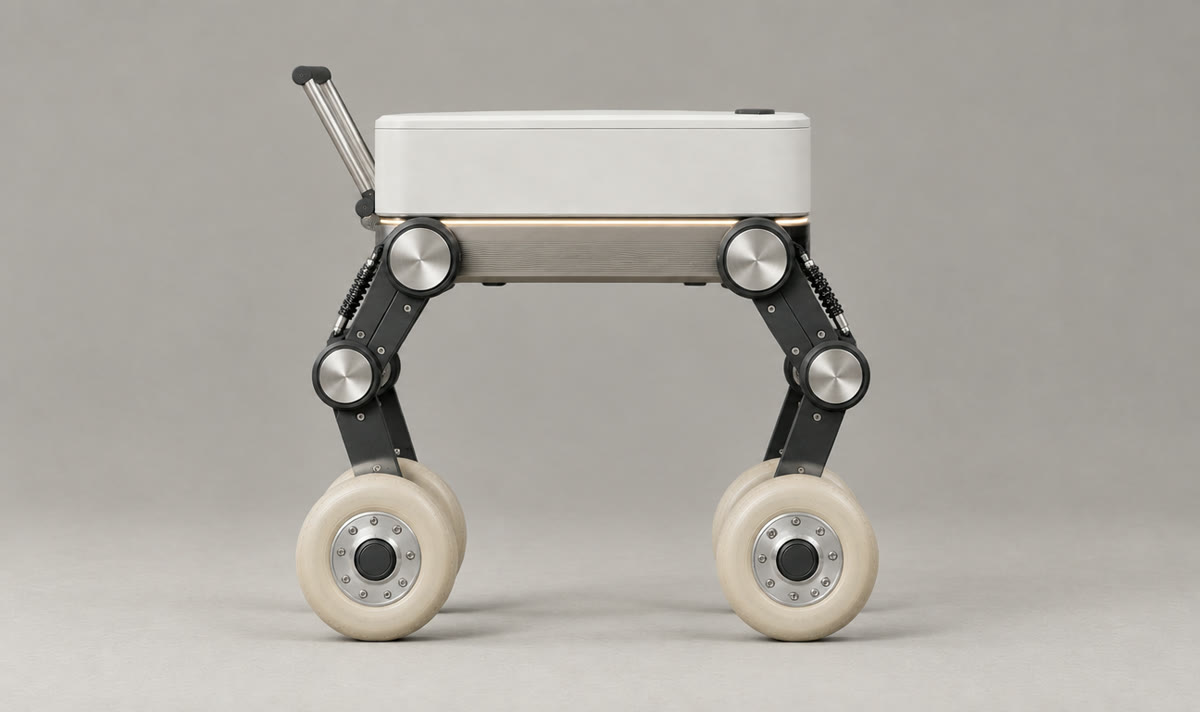
Legs. Four legs, hip and knee, 28 + 28 cm, hips at the chassis corners (x = ±30 cm), knees bending outward. Both motors sit coaxially in the hip housing; a toothed belt in the thigh drives the knee. A coil-over air shock runs along each thigh. Every joint has a spring-applied brake.
Wheels. 305 mm cast polyurethane tyres on machined hubs with in-hub motors. Skid steering through four hubs; no steering actuators.
Handle. Fold-up brushed-aluminium push handle at the rear with a capacitive grip. Push assist when held.
4. Envelope
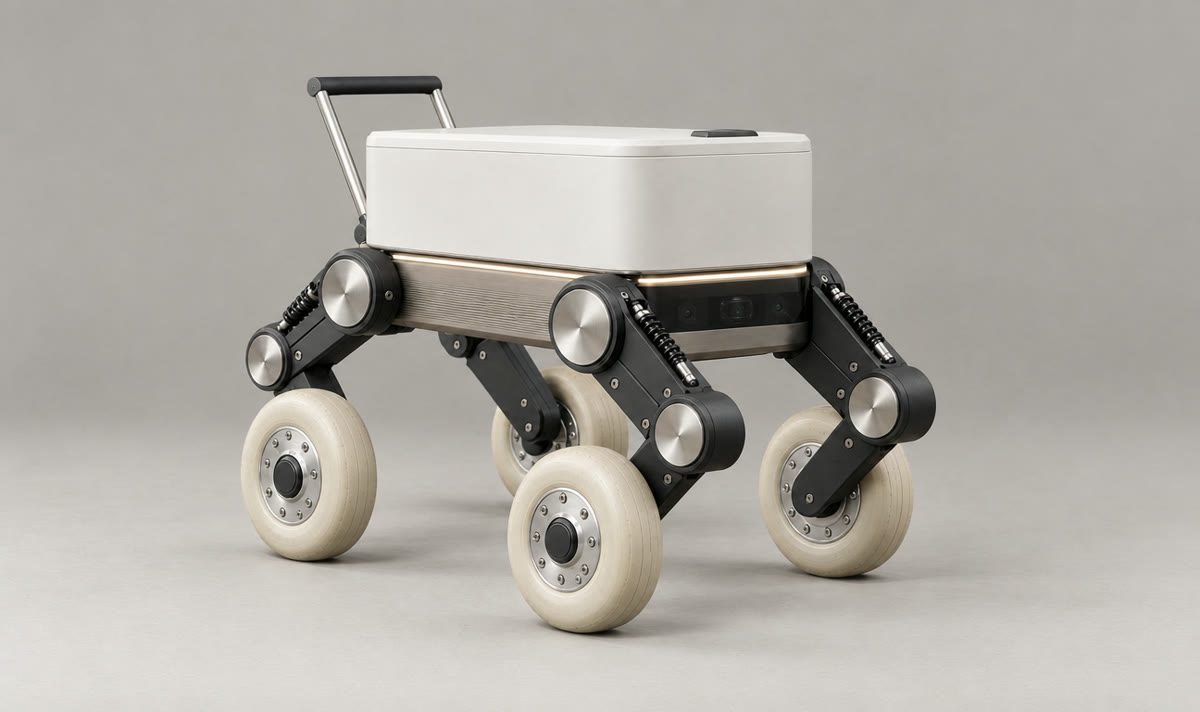
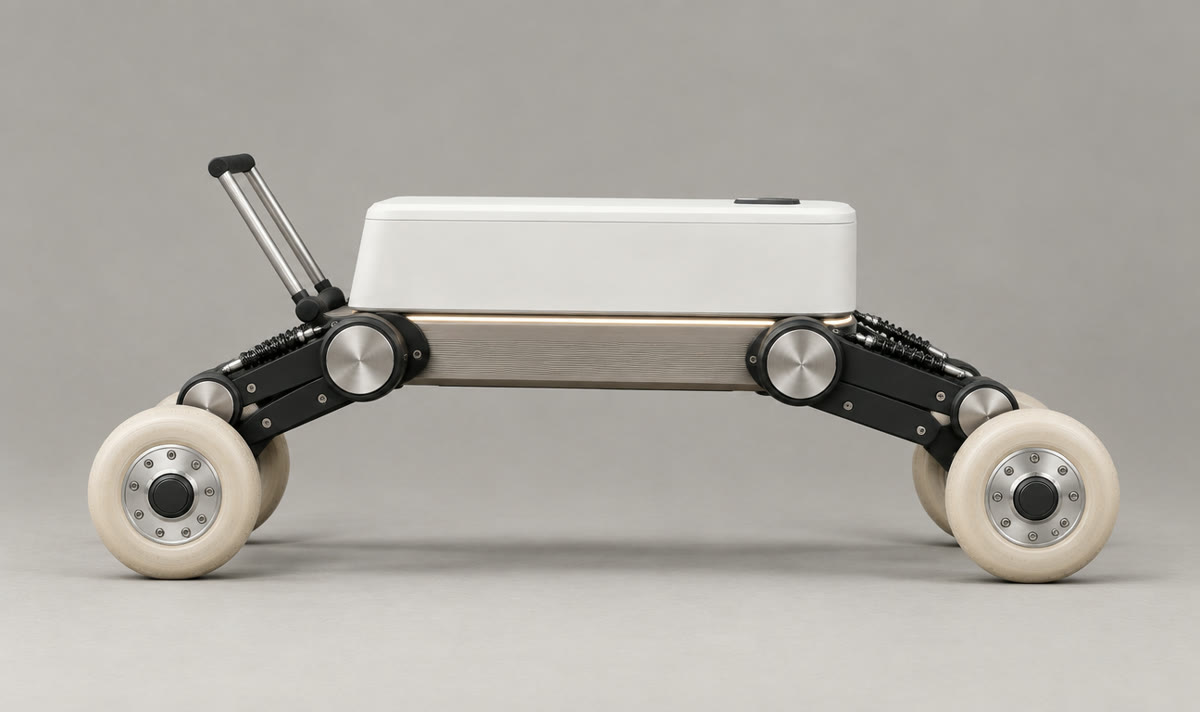
| Item | Value | Basis |
|---|---|---|
| Overall width | 63 cm | Narrower than a manual wheelchair calculated |
| Overall length, walking | 126 cm | Including handle calculated |
| Lid height, kneel / walk / rise | 61 / 87 / up to 110 cm | Loading / hand height / set per person, section 8 |
| Bench (folded) | 116 × 63 × 45 cm | On skids, wheels tucked |
| Mass, no module | 39 kg ±2 | estimate |
| Pitch / roll levelling | ±38° / ±18° | Each leg independent |
| Stairs | rise ≤ 20 cm, going ≥ 24 cm, ≤ 38° | Straight flights only in v1 |
| Kerb, single step | 25 cm | estimate |
| Ground clearance, walking | 31 cm | calculated |
5. Cargo bay
| Item | Value |
|---|---|
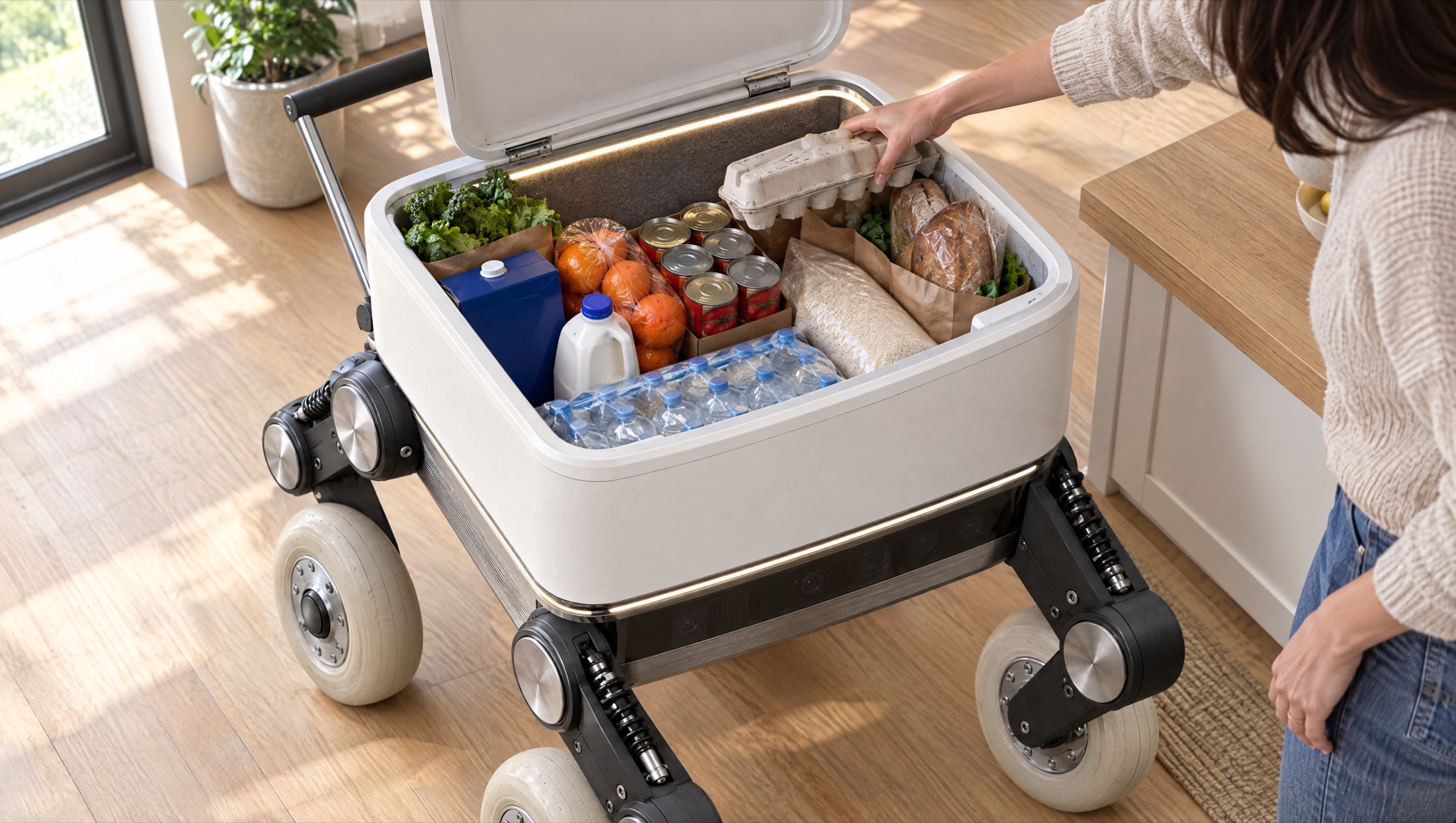
| Internal size | 71 × 35 × 30 cm |
| Volume | 75 L calculated |
| Rated load | 60 kg flat, 40 kg stairs |
| Lining | Removable washable felt, wipe-clean base tray |
| Light | Warm LED strip under the lid lip, on when open |
| Lid | Gas-damped, soft-close actuator, latch with lock |
| Access | Household UWB key, phone, or one-time courier code |
| Weighing | Four hip load cells, ±0.2 kg |
| Weather | Gasketed lid, IP65 closed |
Reference order used for packaging studies: water 24 × 500 ml (12.4 kg), rice 5 kg, milk 4 L (4.1 kg), two pantry bags (4.3 kg), eight cans (3.4 kg), detergent 3 L (3.3 kg), produce, bread and eggs (6.1 kg). Total 38.6 kg; the lid must close over it without force.
Load placement. The robot reads centre of mass from the load cells after loading. If the load is off-centre by more than 8 cm it says so and asks for a shuffle; it never refuses silently.
6. Wheels
| Item | Specification |
|---|---|
| Tyre | Cast polyurethane, Shore 85A, 305 × 70 mm, fine siping for wet grip; bone colour |
| Hub | Machined 6061-T6, bead-blasted, 10 × M5 hex bolts, sealed bearing cap |
| Motor | 48 V in-hub BLDC, 35 N·m peak, 14 N·m continuous, regenerative |
| Wear life | ≥ 3,000 km to 3 mm tread loss estimate |
| Floors | Non-marking on wood, vinyl, tile and carpet |
| Replacement | Tyre and hub swap with one tool in under 10 minutes |
7. Legs and actuation
| Case | Torque | Working |
|---|---|---|
| Stairs, three-wheel support, one leg at half the weight, 25 cm arm | 97 N·m | 0.5 × (39 + 40) × 9.81 × 0.25 calculated |
| With 2× dynamic factor | 194 N·m | Peak requirement calculated |
| Walking at 60 kg, knee offset 25.6 cm, before spring assist | 62 N·m | (39 + 60) / 4 × 9.81 × 0.256 calculated (corrected in C.1 from 21.9 cm) |
| Rise at 110 cm with 60 kg, knee offset 16.2 cm | 38 N·m | (39 + 60) / 4 × 9.81 × 0.162: rising lowers knee torque calculated |
| Specified hip and knee drives (× 8) | 200 / 70 N·m | Peak / continuous. Brake holds 220 N·m unpowered |
Coil-over air shocks give 80 mm travel at the wheel; preload is set automatically from measured load. Knee gas springs carry about 60 % of nominal static load so the legs never sag on power loss.
8. Rise
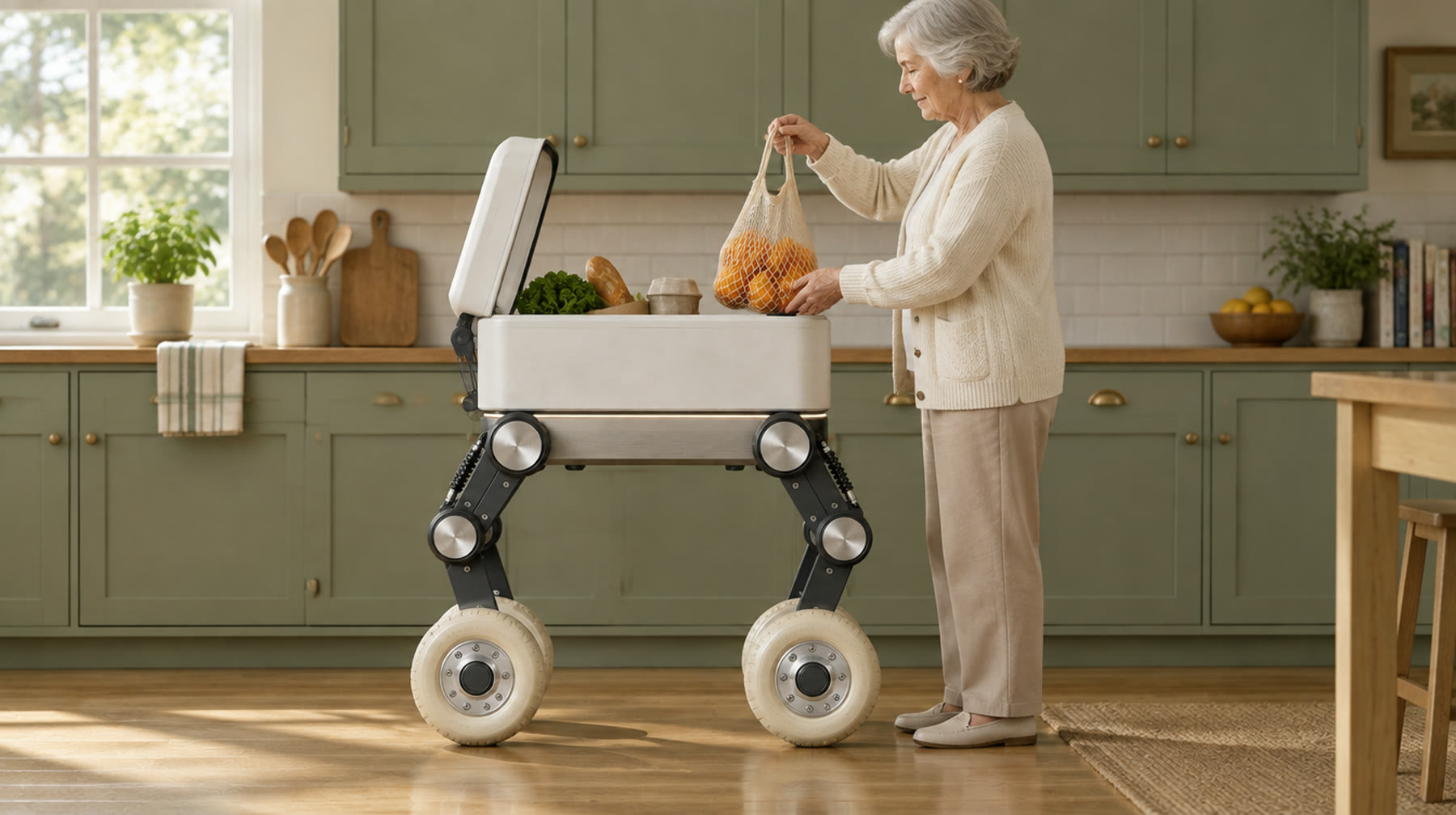
R1 says nobody bends to it. Rise lifts the lid from walking height to a height set for each person, anywhere from 61 cm (kneel) to 110 cm, so the bay comes up to the hands instead of the back going down to the bay.
Geometry
The lid sits 56 cm above the chassis bottom, the hips 7 cm above it. Legs are 28 + 28 cm; wheel radius 15.25 cm. For lid height h: hip height H = h − 49, hip-to-axle d = H − 15.25, knee offset x = √(28² − (d/2)²). Centre of mass with a 60 kg load uses the robot (39 kg) at H + 4 and the load at h − 18; half-track 28 cm, half-wheelbase 30 cm.
| Lid height | Hip | Knee offset | Knee angle | Knee torque, 99 kg | CoM, 60 kg load | Static tip, side / end |
|---|---|---|---|---|---|---|
| 61 cm, kneel | 12 cm | 27.9 cm | 7° | 67 N·m | 32 cm | 41° / 43° |
| 87 cm, walk | 38 cm | 25.6 cm | 48° | 61 N·m | 58 cm | 26° / 27° |
| 99 cm, a 162 cm adult | 50 cm | 22.0 cm | 77° | 52 N·m | 70 cm | 22° / 23° |
| 110 cm, maximum | 61 cm | 16.2 cm | 110° | 38 N·m | 81 cm | 19° / 20° |
calculated Knee torque is before the gas springs, which carry about 60 % of it. The knee is still bent 110° at full rise, so the shocks keep working. Lifting 99 kg at 4 cm/s needs about 39 W.
Suggested height
The app proposes h = 0.58 × stature + 5 cm, clamped to 61 to 110: 99 cm for a 162 cm adult, 106 cm for 175 cm. The rim lands near hip height and the bay floor, 30 cm lower, near knuckle height, so a full load comes out with a straight back. Each person can adjust it; the height follows their key or phone. estimate Confirmed by the trunk-flexion test in section 25.
Rules P1
- Only when stopped, on floor sloped no more than 5° (IMU). It lowers to walking height before any motion and never drives with the lid above 92 cm.
- It looks up first. Time-of-flight sensors on the lid edges need 10 cm clear above the lid and its opening arc. Under a shelf or counter lip it rises only as far as is clear, and says so.
- Slow and soft. 4 cm/s; any unexpected contact (joint current, lid load cells) stops it within 5 mm and lowers 1 cm.
- By hand. P2 Hold the lid grip and lift or press: admittance control follows the hand at up to 6 cm/s and holds where it is let go.
- Leaning. If someone leans on the lid, brakes hold and it will not move until the extra load is gone. It is not sold as a mobility aid.
- Locked out with the Nest fitted, on stairs, and in car entry.
9. Perception
| Sensor | Placement | Specification |
|---|---|---|
| Solid-state 3D lidar | Behind front and rear glass | 120° × 25° FoV, 30 m range, 20 Hz |
| Stereo depth camera | Behind front and rear glass | 90° FoV, 0.3 to 10 m, 30 fps |
| Wide cameras | Four chassis corners | 190°, 30 fps, HDR, night sensitive |
| UWB | Three antennas in the deck | Angle of arrival to the household key, phone or watch |
| Ultrasonic | Under the chassis | Low obstacles and drop-offs below the glass line |
| IMU and encoders | Chassis, all joints | Body attitude, leg state |
| Lid time-of-flight C.1 | Front and rear lid edges, facing up | Clearance above the lid before Rise, 2 m range |
What it recognises
| Class | Behaviour | Clearance |
|---|---|---|
| Its person | Follow, keep in sight, re-identify after occlusion | 1.2 m walk, 2 to 3 m run |
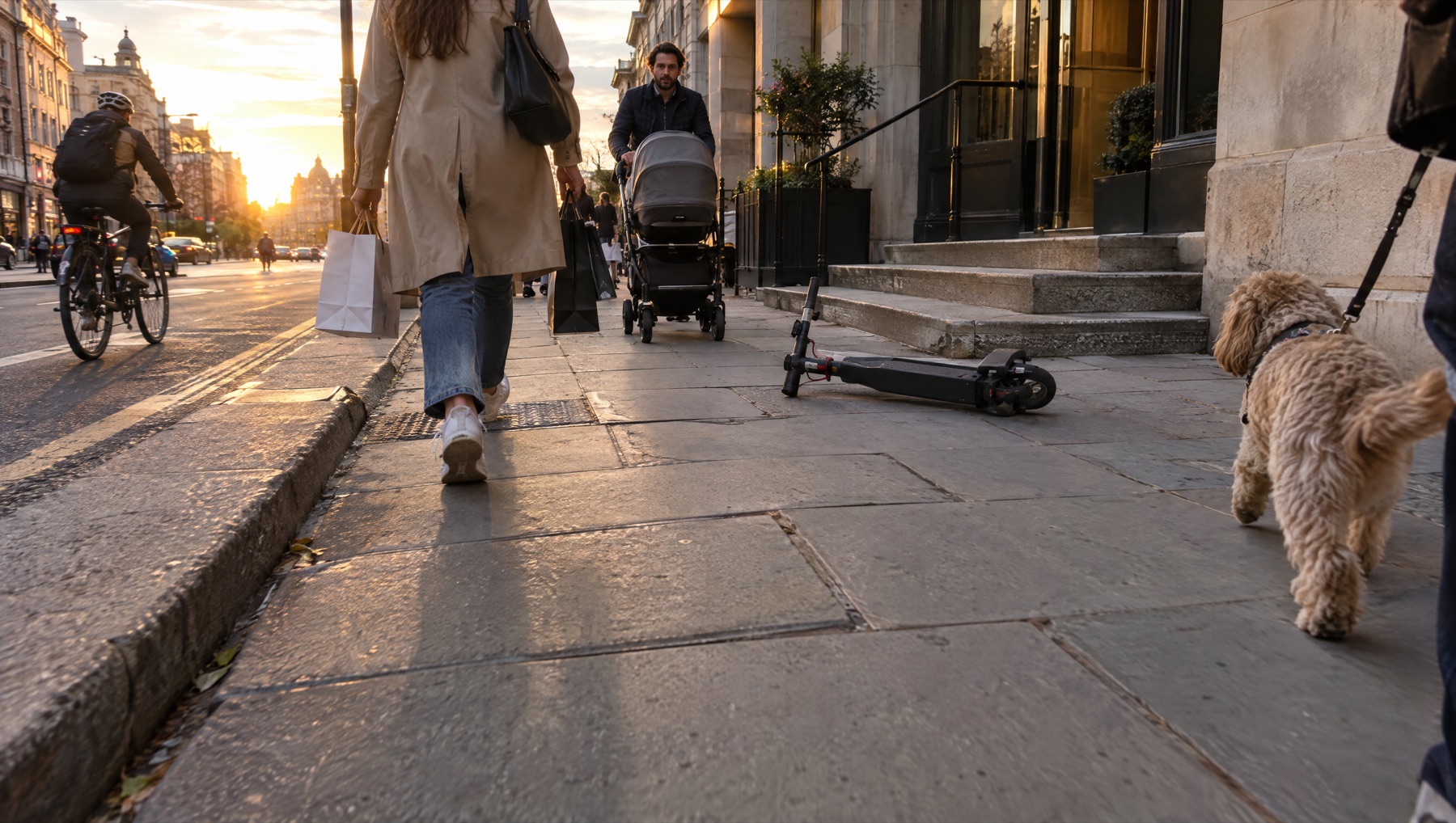
| Pedestrians, prams, wheelchairs, canes | Yield, keep right, slow | ≥ 0.8 m |
| Children, pets | Slow to 3 km/h, widen clearance | ≥ 1.2 m |
| Bikes, scooters (moving) | Predict path, hold | ≥ 1.0 m |
| Static obstructions | Reroute; if blocked, stop and tell its person | ≥ 0.3 m |
| Kerbs, steps, stairs | Measure rise and going; climb if within envelope | n/a |
| Drop-offs, water, glass | Stop | ≥ 0.5 m |
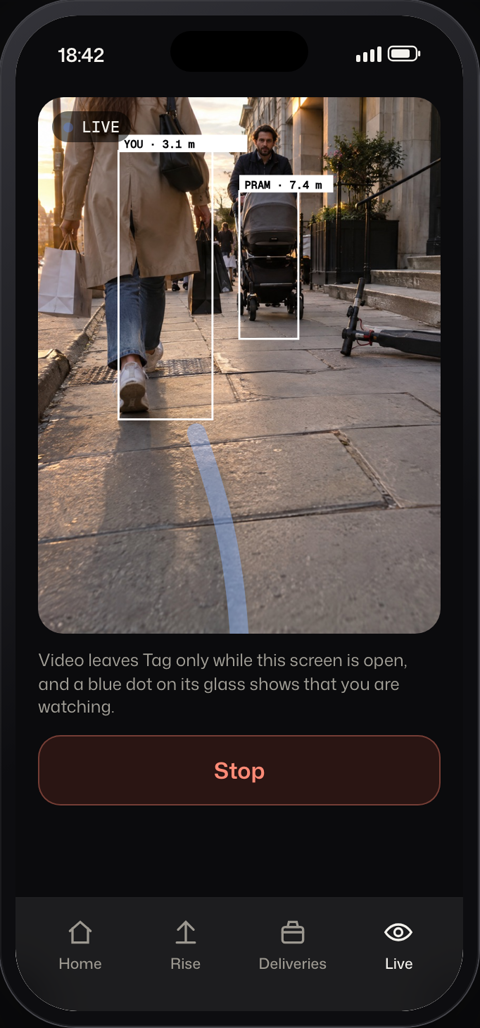
Perception to motion latency ≤ 120 ms. All video is processed on the robot. A visible indicator shows whenever any camera feed leaves the robot (only when the owner shares it).
10. Behaviour
Following
Path replay: Tag retraces the line its person took, or walks alongside on wide ground. Losing the person for 3 s means stop, hold, amber state, buzz the key. It never drives off to search.
Stairs P6
Statically stable crawl. Before each wheel lifts, the load cells locate the centre of mass and the body shifts inside the triangle of the other three wheels. About 2.5 s per step at 40 kg. Square-on approach only.
Speeds
| Context | Limit |
|---|---|
| Indoors, corridors | 3 km/h |
| Lifts | 1 km/h |
| Pavements | 6 km/h |
| Trails, following a runner | 16 km/h |
| Child on board | 4 km/h |
11. Buildings
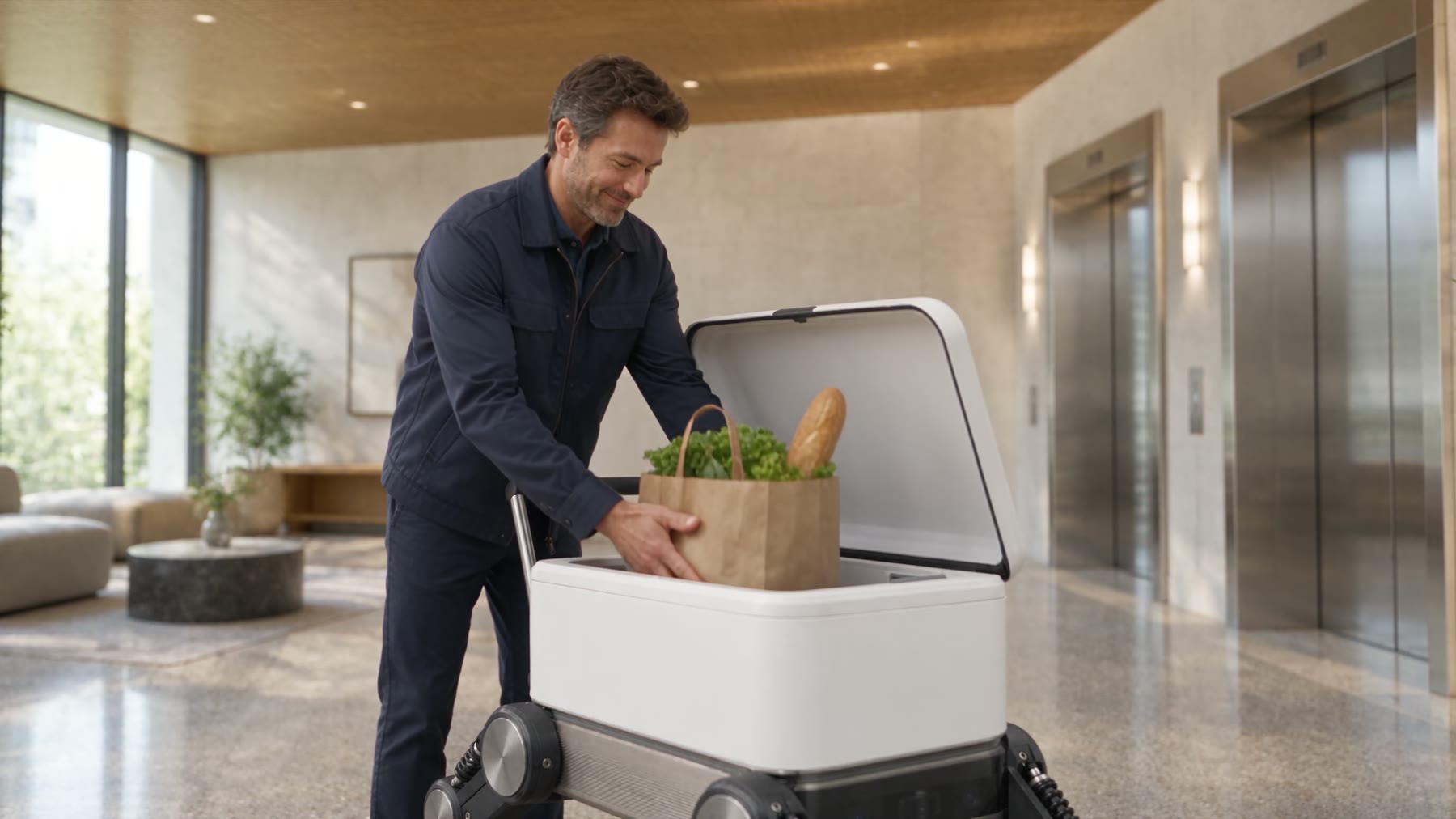
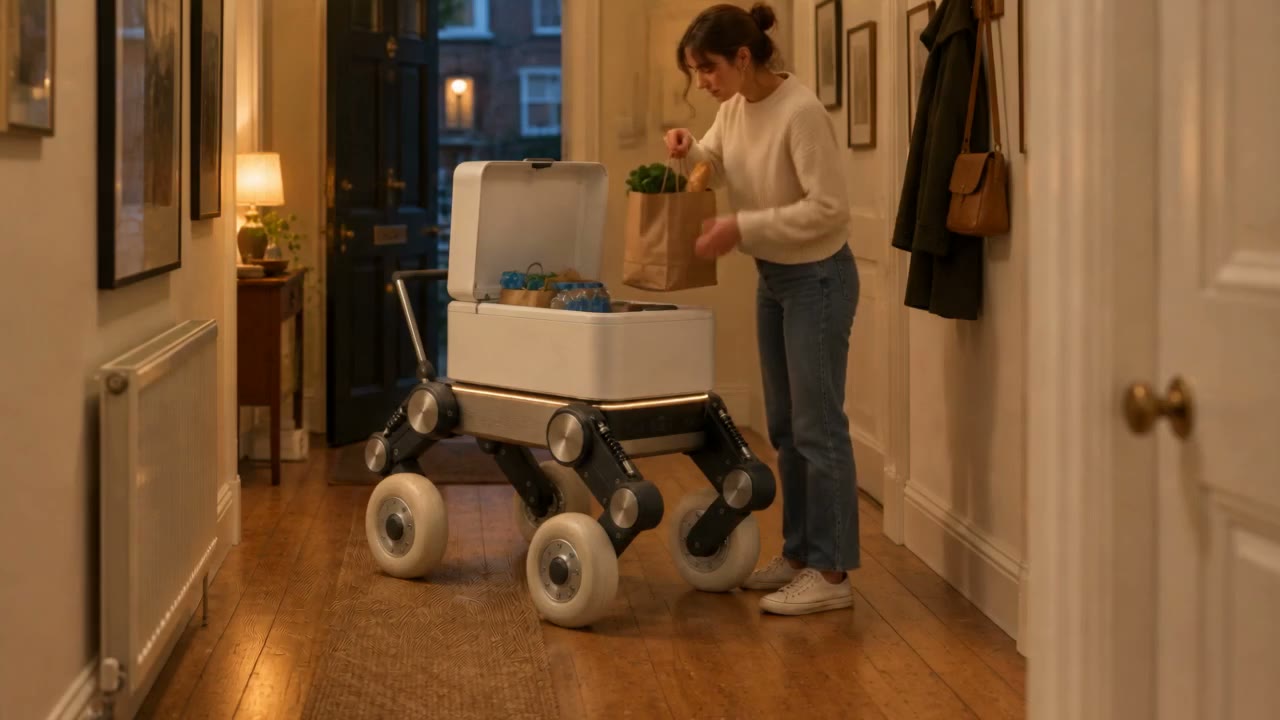
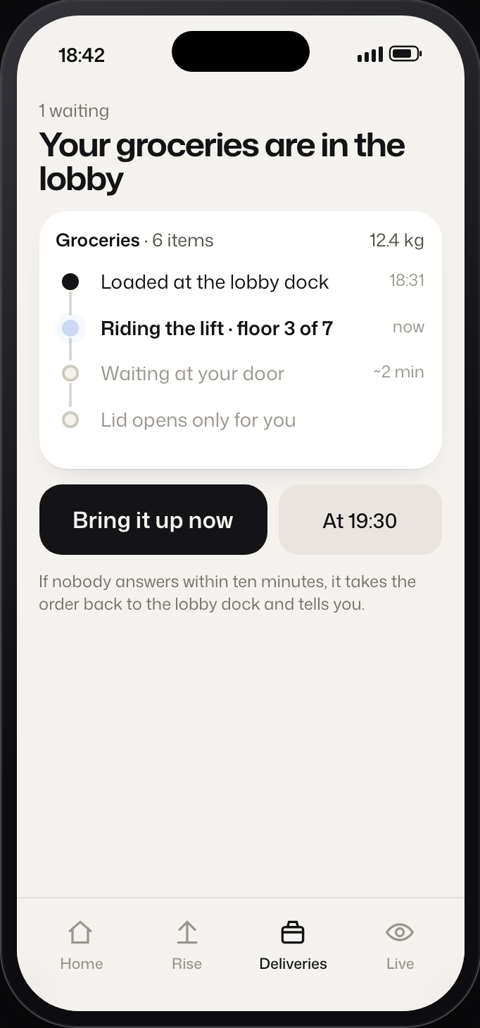
A fleet of two to six Tags charges at a lobby dock. A courier scans the dock code; the nearest Tag rolls out, opens, and locks once loaded. It calls the lift through the lift maker's robot interface (fallback: stick-on button actuator), rides parked against the back wall, travels corridors at 3 km/h keeping to one side, and stops at the door. The resident gets one notification; the lid opens only for their household. If nobody answers within ten minutes it returns to the dock.
| Item | Target |
|---|---|
| Dock | 2 to 6 bays, 300 W each, fits a 1.2 × 2.4 m alcove |
| Lift integration | Lift-maker robot APIs; button actuator fallback |
| Doors | Access-control API for lobby and corridor doors |
| Proof of delivery | Lid sensor and weight change logged; no photos of residents |
| Throughput | ≥ 6 deliveries per robot per hour in a 10-floor building estimate |
12. Car entry
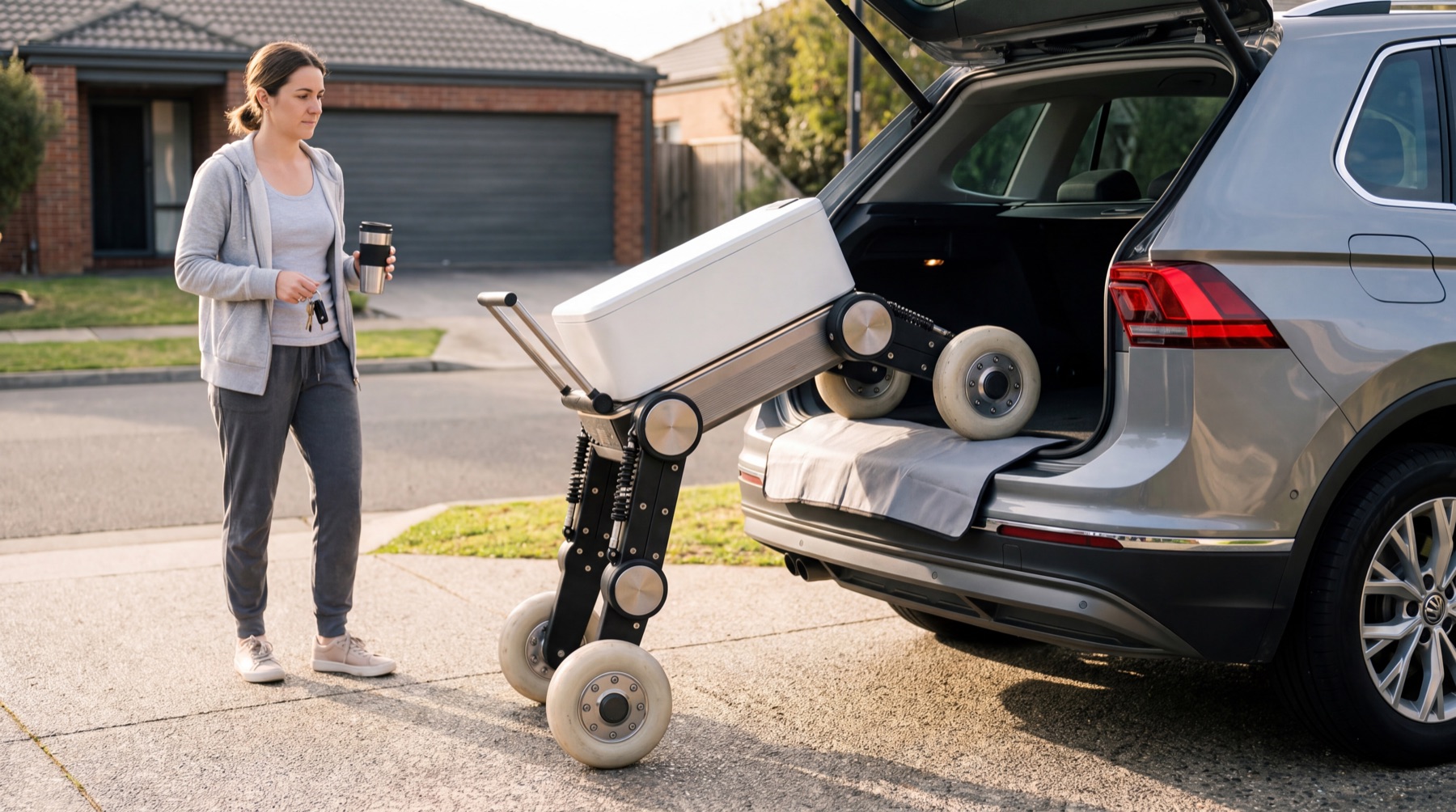
Depth cameras map the opening, lip and floor first; the robot refuses if any clearance is under 5 cm. Front legs place both front wheels on the protective mat; the chassis pitches nose-up to clear the lip; rear legs push, then each rear wheel steps in. Inside, it folds to bench height. Boot floors up to 75 cm. Robot only, payload ≤ 10 kg. P3
- No paint contact. Wheels lifted 5 cm clear of the bumper before moving forward.
- Force-limited. Every joint halts at 15 N of unexpected contact.
- Soft edges. Chassis nose, glass edges and leg plates covered in non-marking polymer.
- Mat in the box. Thin magnetic boot-lip guard and mat included.
risk Tailgate clearance and boot-floor grip vary by model; test on the top 30 selling SUVs and hatchbacks.
13. Modules
Each module tells the safety controller what is fitted, and the controller enforces that module's limits. P5
| Module | Specification | Behaviour profile |
|---|---|---|
| Bay (standard) | 75 L covered, locked, lit | Courier mode, proof of delivery |
| Flatbed | 80 × 42 cm deck, 4 cleats, 60 kg | Low stance, gentle acceleration, convoy up to 4 |
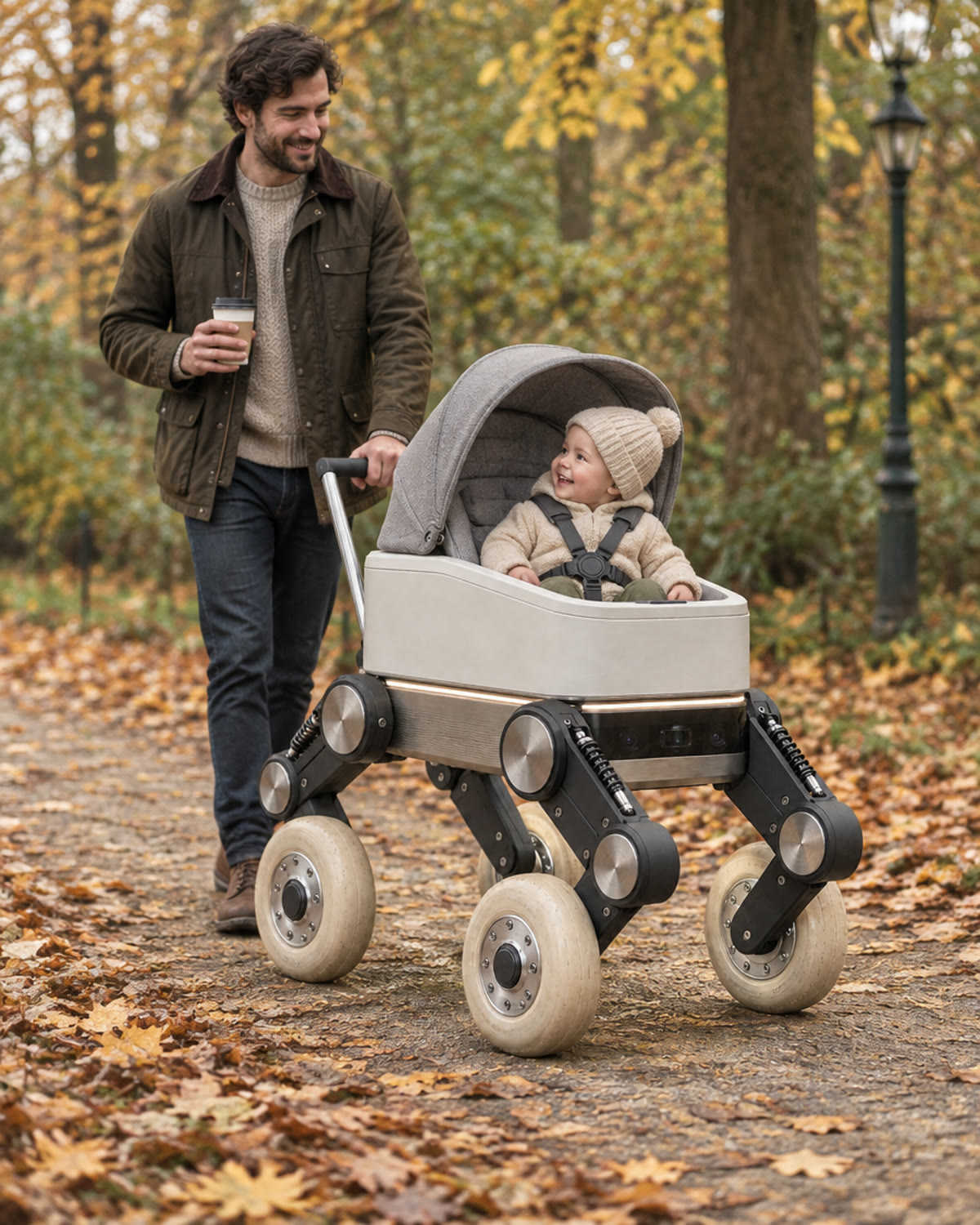
| Nest | One child, 9 months to 4 years, ≤ 22 kg; deep shell set into the body, 5-point harness, canopy | 4 km/h, no stairs, slopes ≤ 8°; kneels to put the seat at waist height; harness sensors must read closed to move |
| Cooler | 40 L, 5-day ice | Trail profile, run stance allowed |
14. Interaction
| You do | Tag does | Sensed by |
|---|---|---|
| Tap the rim twice | Pairs and follows | Capacitive rim, UWB, cameras |
| Press the lid | Stops and kneels | Hip load cells |
| Lift the lid grip | Unlocks for the household, opens softly | UWB key, lid actuator |
| Hold the handle | Push assist, like a weightless cart | Capacitive grip, hub current |
| Lift the lid grip and keep lifting | Rises with your hand, stops when you let go | Grip force, hip load cells |
| "Tag, come here" / "Tag, rest" | Comes to you / returns to its dock and sleeps | Microphones, UWB |
| Open the app | Come to me, rise, send home, deliveries, live view | Phone, section 15 |
Light line states (four, no more): white following; slow amber waiting; green locked with a delivery; red needs help. At rest the line is off; a dot on the dock breathes while charging and holds steady when full. A soft tone and light precede every start or turn within 2 m of a person.
15. Mobile app
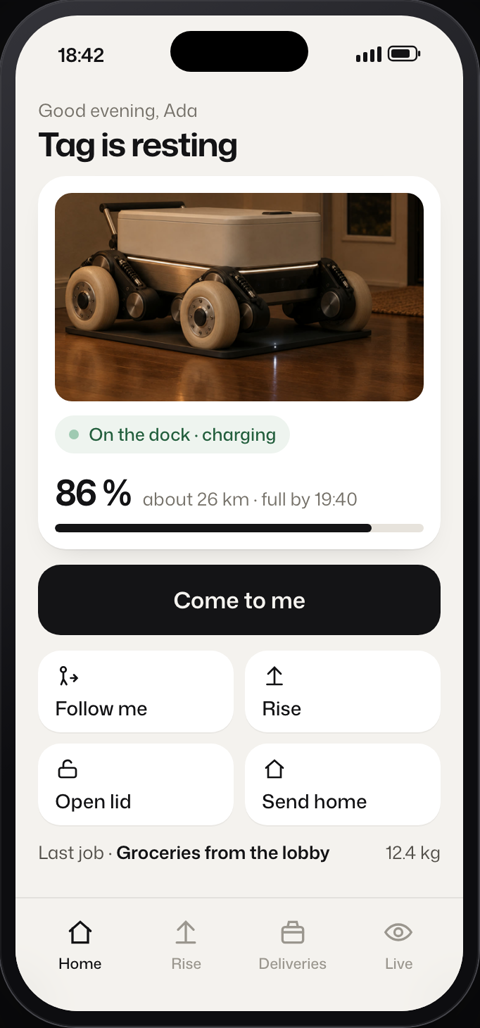
iOS 17 and Android 12 onward, one app for households; building managers use a web console. The app is a requester: every command goes to the safety controller, which owns all limits and can refuse. Nothing safety-critical needs the app, and nothing in the app can exceed a limit.
Setup, about ten minutes
- Scan the code under the lid. Proves physical access; pairs over Bluetooth LE and joins Tag to the home Wi-Fi.
- Height. Stature in, suggested lid height out (section 8). Repeated for each person added.
- One lap of the home. Builds the map: rooms, doors, thresholds, stairs flagged, dock position chosen.
- Household. Invite people; each gets a role, a key or phone, and a lid height.
| Area | Specification |
|---|---|
| Screens | Home, Rise, Deliveries, Live, Household, Settings (dock, map, privacy, updates) |
| Commands | Come to me, Follow me, Rise, Open lid, Send home, Stop |
| Links | Bluetooth LE nearby; home Wi-Fi; away through an end-to-end encrypted relay, keys held on the robot |
| Come to me | Phone UWB for position; fallback Wi-Fi position on the home map, then a spoken "where are you?" |
| Latency | Command to motion ≤ 1 s on Wi-Fi, ≤ 2 s through the relay; Stop ≤ 150 ms |
| Lost link | Continuous commands carry a 500 ms heartbeat. On loss it finishes the safe part of the action, stops and holds; it never drives on a stale command |
| Roles | Owner; household; guest (time-limited, follow and open only); courier (one-time code from the building or shop, load only); building manager (web, fleet, no cameras) |
| Privacy | Video leaves the robot only while Live is open, with a blue dot on the glass. Nothing stored by default; clips only on request, kept 30 days |
| Accessibility | WCAG 2.2 AA; Dynamic Type to 200 %; VoiceOver and TalkBack labels; 48 pt targets; primary actions in the bottom third; no time limits; haptic confirmation |
| Notifications | At your door; waiting in the lobby; charged or low; needs help; update installed. Quiet hours |
| Updates | Signed, installed only at rest on the dock, with automatic rollback |
16. Empathy requirements
Each is a release test.
- It comes to you. No interaction needs a hand below 45 cm or above 90 cm.
- It warns before it moves. Light and tone at least 0.5 s ahead within 2 m.
- It never strands you. Stops safely and says so; reports "enough to get home" while true.
- It gives way. Half the pavement at most; back of the lift; yields to wheelchairs, prams and canes.
- It knows who is on board. Child profile within 1 s, not overridable.
- It keeps your dignity. A well-made object, never a medical aid.
- It respects privacy. On-device video; visible indicator when shared.
- It fails gently. Brakes hold, springs carry, slow kneel; wheels freewheel for pushing.
- It is kind to strangers. One sentence and a green line for couriers; no one else can call it.
- It is calm. ≤ 45 dB(A) at 1 m walking, ≤ 55 running. No fake emotions.
17. Twenty laws as product requirements
| Law | Requirement on the robot |
|---|---|
| Hick | No more than four modules and five stances a person chooses (walk, kneel, rise, rest, bench); run and stairs switch on their own |
| Fitts | Lid grip at resting-hand height; whole rim touch-sensitive |
| Jakob | Behaves like a cart, a pram and a dog that follows; pushing always works |
| Miller | Four light states maximum |
| Doherty | Light response to any touch within 100 ms |
| Tesler | Levelling, routing and mode selection automatic |
| Postel | Accepts voice, touch, push, phone and watch |
| Occam | No screen, no buttons, no face |
| Pareto | Shopping and building delivery tuned first |
| Peak-end | Arrival choreography: stop, settle, lid lifts, light warms |
| Von Restorff | One distinct state per moment on the light line |
| Serial position | Every manoeuvre starts with a warning and ends with a settle |
| Zeigarnik | Announces what remains: trips, minutes, distance home |
| Goal gradient | Counts down multi-trip jobs |
| Proximity | All touch controls on the rim and handle |
| Similarity | Same latch on every module |
| Common region | Light line encloses the robot |
| Uniform connectedness | Both leg drives in one hip housing |
| Prägnanz | Silhouette reads as a box on four legs |
| Aesthetic-usability | Machined metal, real polyurethane, flush glass throughout |
18. Power
| Item | Value | Notes |
|---|---|---|
| Battery | 2 × 450 Wh, 48 V | Hot-swappable one at a time, 2.4 kg each |
| Walking draw, 30 kg | ≈ 110 W | estimate |
| Trail draw | ≈ 350 W | estimate |
| Range | 30 km walking, 25 km trail | With 10 % reserve calculated |
| Charging | 300 W dock, 0 to 80 % in 1.9 h, full in 2.8 h | Kneels onto the dock pads; section 19 |
| Asleep | ≈ 4 W | Sensors and drives off; about 9 days from full off the dock calculated |
19. Rest and dock
| Item | Specification |
|---|---|
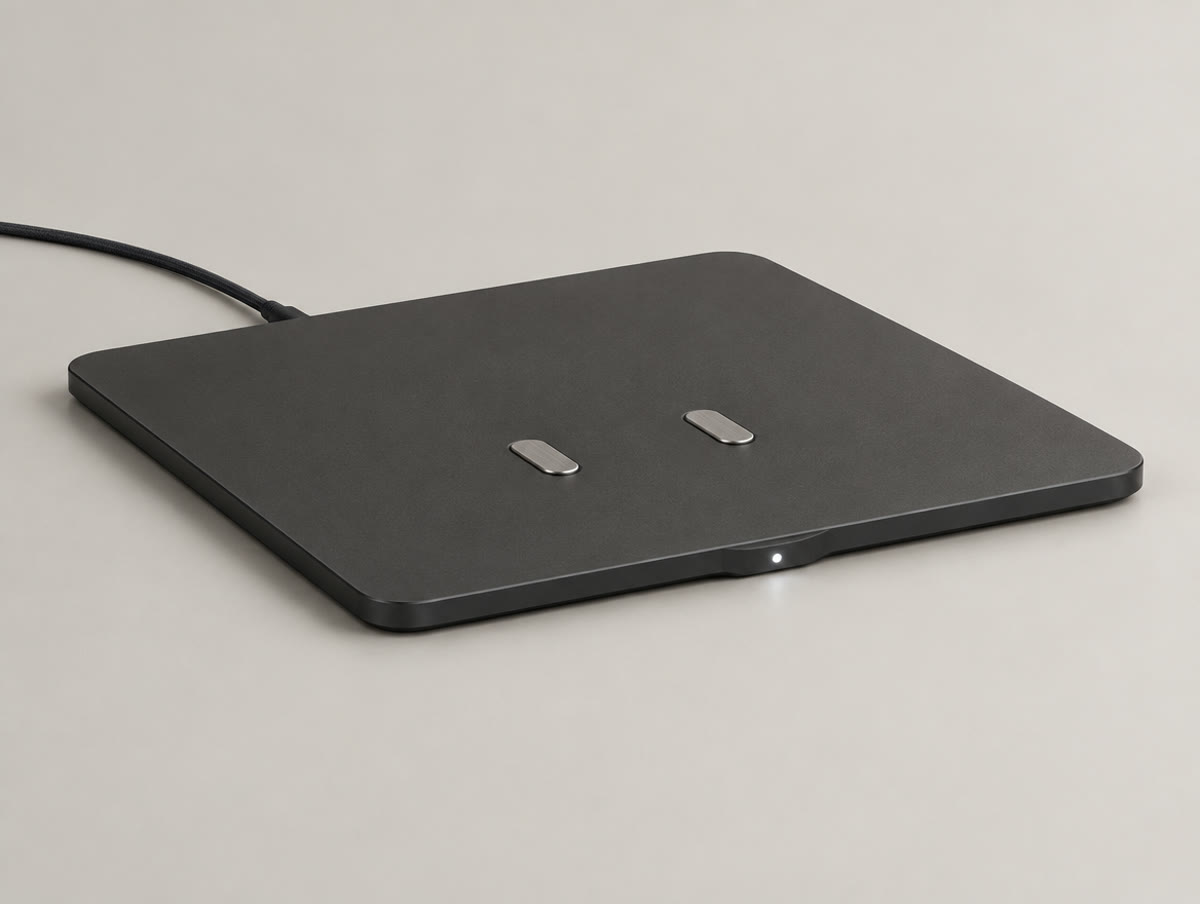
| Plate | 100 × 64 × 1.5 cm powder-coated aluminium, 8° chamfered edges, rubber feet; works on carpet up to 15 mm pile |
| Contacts P4 | Two flush spring pads meeting plates under the chassis centre line; 48 V, 300 W. Dead until Tag is on them (contact sense plus a Bluetooth handshake), so 0 V to fingers, paws and spills |
| Supply | 300 W external supply, 2 m fabric cable from the back edge |
| Alignment | Fiducial on the plate and a UWB anchor in the dock; ±2 cm and ±3° before kneeling. Contact is made by kneeling, never by driving into it |
| Space | 1.6 × 1.0 m of clear floor with Wi-Fi; never on a stair landing |
| Cost | $45 bill of materials, in the box; an extra dock is $149 estimate |
At rest
- Still. Kneeling (centre of mass 32 cm, tip angle above 40°), brakes on, leg drives off. A child pulling the handle cannot tip or move it.
- Private. Cameras, lidar and microphones are powered off, not just muted. A wake word is opt-in per household.
- Dark. The light line is off; only the dock dot shows charge.
- Wakes on an app call, the household key within 2 m plus a touch, a lid touch, a schedule or a building job.
- Returns after every job, after 10 minutes idle at home, and at 15 % from anywhere, keeping enough range to get back. If the dock is blocked it waits beside it and says why.
20. Electronics
| Function | Hardware |
|---|---|
| Main compute | Edge AI module, ≈ 100 TOPS, 25 W class |
| Safety controller | Separate dual-channel MCU; owns brakes, speed limits, module profiles and stop. Only it can grant motion |
| Connectivity | Wi-Fi 6, Bluetooth LE, UWB, LTE-M |
| Audio | Four-microphone array, one speaker |
| Lighting | Seam light line (addressable), bay strip, indicator, blue live-view dot |
| Dock | Contact-sense and handshake controller, UWB anchor, status light |
21. Safety and certification
| Topic | Target |
|---|---|
| Robot | ISO 13482; safety controller to IEC 61508 principles |
| Battery | IEC 62133-2 cells, UL 2271 pack |
| Ingress | IP65; −10 °C to +45 °C |
| Pinch points | All gaps through full motion < 8 mm or > 25 mm |
| Nest | Child-restraint design to pushchair standards; certified before sale |
| Radio | FCC, CE, regional UWB |
| Pavements | Configurable to local personal-delivery-device rules |
22. Mass and cost
| Group | Mass | First run, 10,000 a year | Volume, 100,000 a year |
|---|---|---|---|
| Leg drives with brakes, × 8 (one actuator design for every joint) | 12.8 kg | $640 | $440 |
| Wheel modules (PU tyre, hub, motor), × 4 | 9.2 kg | $240 | $160 |
| Leg plates, belts, shocks, gas springs, × 4 | 4.2 kg | $200 | $130 |
| Chassis and upper shell with lid (cast and stamped at volume) | 6.2 kg | $190 | $120 |
| Battery packs, × 2 | 4.8 kg | $190 | $140 |
| Compute, safety controller, sensors, glass (one lidar, cameras at the rear) | 2.2 kg | $420 | $300 |
| Harness, lights, audio, boards | 1.6 kg | $110 | $70 |
| Total | 41.0 kg | $1,990 | $1,360 |
estimate Budgets to design to; the volume column is the cost ceiling of $1,500 that every group is held under. Target retail $4,900, or $129 a month; building fleets leased per unit. Hardware gross margin at target price: 59 % on the first run, 72 % at volume. Mass target remains 39 kg; current budget is 2 kg over. The dock ($45) and lid time-of-flight sensors ($6, inside the sensors line) are new in C.1.
23. Benchmarks
| Robot | Payload | Top speed | Stairs | Owned | Covered bay | Car entry |
|---|---|---|---|---|---|---|
| Rivr TWO (Amazon) | 27 kg | 14 km/h | Yes | No | 55 L | No |
| Piaggio gita plus | 18 kg | 10 km/h | No | Yes | Small | No |
| Unitree B2-W | 40 kg | 15 km/h | Yes | No | No | No |
| Tag rev C | 60 kg | 16 km/h | Yes | Yes | 75 L, locked | Yes |
24. Intellectual property
Working assessment from a desk search on 4 October 2026. It is not legal advice: every item needs a professional search and a patent attorney before anything is filed.
Position
The concept as a whole is prior art and cannot be claimed: a wheel-legged stair-climbing carrier, a level cargo bay, person following, lobby-to-door delivery with lifts, self-docking, and raising a container toward the user all exist in patents or products. The protectable value is in the specific mechanisms and control methods below, in the industrial design, and in know-how kept secret.
Patent candidates
| ID | Invention | Core of the claim | Closest prior art found | Strength |
|---|---|---|---|---|
| P1 | Personal rise, section 8 | Lid height set per person from stature and tied to their key or phone; wheels held under the hips so wheelbase and track stay constant while rising; upward sensing of the lid and its opening arc before rising, stopping at the clearance limit; rise only when stopped on floor ≤ 5°; automatic lowering to driving height before any motion | Container elevation on delivery robots (US 10,459,450 B2); positioning by user attributes (US 11,806,861); Savioke cargo robot (US 9,535,421 B1) | Moderate, as a combination on a wheel-legged body |
| P2 | Hand-guided rise, sections 8 and 14 | Admittance control of the whole legged body from lid-grip force and hip load cells: the body follows the hand up or down, holds on release, and backs off 1 cm on unexpected contact | Hand-guided industrial arms; nothing found on legged carriers | Moderate to strong, pending a dedicated search |
| P3 | Self-loading into a car, section 12 | Map the boot opening, lip and floor; refuse under 5 cm clearance; wheels allowed only on a recognised protective mat; place front wheels, pitch the chassis over the lip, then step each rear wheel in; 15 N stop on every joint | Not yet searched | Unknown, promising |
| P4 | Kneel-to-contact dock, section 19 | Contact made by lowering the body onto a drive-on plate with the legs, never by driving into contacts; pads stay at 0 V until contact sense and a Bluetooth handshake | Docks for legged robots (US 12,560,937); auto-docking (US 8,749,196 B2); legged charging (US 2007/0216347 A1) | Weak to moderate |
| P5 | Module-defined behaviour, section 13 | The safety controller identifies the fitted module and enforces its profile, for example the Nest: 4 km/h, no stairs, no rise, harness interlock | Tool identification on modular robots | Moderate at best |
| P6 | Load-aware stair crawl, section 10 | Bay-floor load cells measure the centre of mass and the body shifts inside the triangle of the three supporting wheels before each wheel lifts | Wheel-legged stair climbers (Rivr, WO 2023/205766 A1, Zero Carrier); statically stable gaits | Weak unless tied to a specific method |
Not claimable
| Feature | Why |
|---|---|
| Following a person's exact path | Follow-the-leader path tracking is known; Piaggio Fast Forward holds following patents |
| Level bay on stairs | MOBINN, Zero Carrier and others keep the load box level |
| Lobby fleet, lift integration, locked bay | Savioke / Relay Robotics products and patents |
| App as a requester, safety controller decides | Standard safety architecture |
| Sensors powered off at rest | Obvious privacy measure |
Other protection
| Type | What it covers | When |
|---|---|---|
| Design patents | The robot's appearance (shell, chassis band, leg plates, hubs), the dock plate, and the app screens, which US design patents can cover | At design freeze, before any public launch |
| Trade secrets | Stair gait and balance tuning, perception models and training data, following parameters, docking thresholds. Kept out of this brief, in an access-controlled repository, under NDA | Now |
| Copyright | Site, film, app code and copy. Generated imagery may have limited protection where there is no human authorship | Automatic |
| Trademark | The working name Tag conflicts with Piaggio Fast Forward's PFFtag following module in the same field. A new name must be cleared before launch spend | Before naming is final risk |
Freedom to operate
Other people's patents are a bigger exposure than our own. A professional freedom-to-operate review covers legs and stairs (Amazon / Rivr), docks for legged robots (Boston Dynamics and others), person following (Piaggio Fast Forward), and delivery compartments with lift integration (Relay Robotics), and must finish before Prototype 2 tooling.
Rules
- This brief is confidential. No public posting or shared links until US provisional applications for P1 to P3 are filed.
- Disclosure clock. The US allows 12 months after our own disclosure; Europe and China generally require absolute novelty, so any public disclosure before filing loses rights there.
- Enablement. Each candidate gets a written invention disclosure with drawings, control logic, and alternative versions, enough for an engineer to build it.
- Ownership. Everyone who contributes signs an invention assignment before contributing.
Filing plan
- Now. Invention disclosures for P1 to P3; patentability searches; US provisional applications (filing fees from about $65 to $325 depending on entity size, plus attorney time).
- Within 12 months. Non-provisional and PCT applications for the candidates that survive search.
- At design freeze. Design patents for robot, dock and app screens; trademark filing for the cleared name.
- Before Prototype 2 tooling. Freedom-to-operate opinion.
25. Acceptance tests
| Test | Pass |
|---|---|
| Reference order load | 38.6 kg reference order fits, lid closes without force, 100 of 100 times |
| Stairs, 18 / 28 cm, 40 kg | 500 flights up and down, zero falls, ≤ 2.5 s per step |
| Car entry, 72 cm boot floor | 200 entries and exits, zero falls, zero paint contact (witness film) |
| Perception, reference scenes | All classes in section 9 detected at stated ranges in ≥ 99.5 % of frames; ≤ 120 ms to motion |
| Building run, 10 floors | 500 lobby-to-door deliveries, ≥ 99 % without human help |
| Trail following | 95 % of 10 km runs at 12 km/h with no loss over 5 s |
| Child lockout | Never above 4.2 km/h, never enters stairs, 1,000 scripted attempts |
| Wheels | 3,000 km wear rig; no marking on six floor types |
| Noise, water, battery | E10 limits; IP65; 1,000 cycles to 80 % |
| Rise stability | 60 kg at 110 cm on a tilt table: no wheel lift below 18° side or end; 2,000 rise cycles; zero contact with a 30 cm overhang fixture |
| Rise for real people | 30 adults, 150 to 195 cm, unload the reference order with trunk flexion under 20° (motion capture) in ≥ 90 % |
| Docking | 1,000 returns from 10 start points, ≥ 99.5 % first time; pads at 0 V whenever unoccupied |
| Rest | ≤ 5 W asleep; cameras, lidar and microphones draw 0 mA (measured) |
| App | Setup ≤ 10 min for 90 % of 30 first-time users aged 65+; command to motion ≤ 1 s in 99 % of 1,000; Stop ≤ 150 ms |
26. Open risks
- Car entry across boot geometries and floor materials.
- Stair crawl transitions at 40 kg on worn, narrow treads.
- Mass: budget 41 kg against a 39 kg target.
- Perception at 16 km/h in dense forest (UWB multipath, latency).
- Lift integration across older lift controllers.
- Regulation of pavement robots and of carrying children.
- Cost against the $1,500 bill-of-materials ceiling and the $4,900 target.
- Rise near counters, shelves and leaning people: overhang sensing and lean behaviour.
- App reliance for older owners: keep the no-app path complete; family-assisted setup.
- Docking on deep carpet and in narrow hallways.
- Intellectual property: name conflict, and freedom to operate against Rivr, legged-dock and following patents.
Build order
Prototype 1: leg-and-chassis mule proving K1 and K2. Prototype 1 also proves Rise (K8). Prototype 2: full platform with bay, perception, building software, dock and app alpha. Beta: Nest, flatbed, cooler, certification.
Competitor figures are public as of October 2026. Tag figures are targets or calculations from them; none is measured. Images are generated renders of the design.